Showing posts with label SCR-270. Show all posts

Tuesday, January 7, 2014

SCR-270 radar

SCR-270 Early Warning Radar

From Wikipedia, the free encyclopedia

SCR-270: Similar to the model that detected the attacking Pearl Harbor planes (the actual Opana antenna was nine dipoles high by four wide, instead of the eight-by-four configuration shown here). The scale for reading the direction the antenna is pointing to can be seen at the base.

The SCR-270 (Signal Corps Radio model 270) was one of the first operational early warning radars. It was the U.S. Army's primary long-distance radar throughout World War II and was deployed around the world. It is also known as the Pearl Harbor Radar, since it was a SCR-270 set that detected the incoming raid about half an hour before the attack commenced.

Tuesday, October 1, 2013

Abandoned Radar Station

Abandoned Radar Station

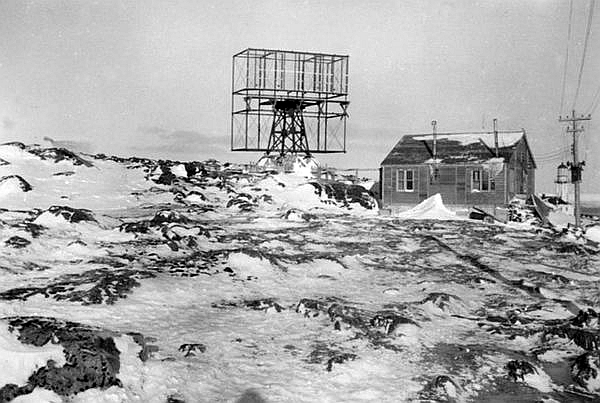
The site gizmodo published this photo with reference as “SCR-270 Radar in the United States”

The product of nearly two decades of work by the US Signal Corps, the SCR-270 was the first radar detection system ever used by the Army. It took a team of nine to operate, and was only good up to 150 miles-more than enough to detect a Japanese plane on the morning of Pearl Harbor, though the warning went unnoticed.

It does not look exactli as other knoun photos (one, two, three). But what is it and what is the source of this photo?

Thursday, July 19, 2012

Lifting the Fog: A Brief History of Radar

One of the worst airplane disasters in history occurred as a consequence of a series of unfortunate events. The location of the disaster was the island of Tenerife, the largest and most populated island of the Canary Islands, on March 27th, 1977. Two Boeing 747 planes prepared for departure on a crowded runway where they were instructed to follow a procedure called “backtaxi” where a portion of the runway is used as a taxiway for aircraft to taxi in the opposite direction from which they will take off. Through a series of misinterpreted communications between air traffic controllers and the pilots, one of the planes began their take off before the other, backtaxiing plane had cleared the same runway. Dense fog shrouded the planes from sight and they did not realize that they were barreling towards disaster until they were 2,000 feet from each other. A detailed account of the events of this fateful day can be found here.

Computer rendering of the Tenerife disaster. Source: http://www.nycaviation.com

Of all the events that led up to the disaster, the straw that broke the camel’s back was a dense layer of fog that clouded the two planes from each others', and the air traffic controller’s, vision. Unfortunately, the small airport on Tenerife was not equipped with ground-based radar, a tool that would have allowed the controllers to see the location of the planes even with the heavy cover of fog. Although this disaster happened 35 years ago, ground-based radar technology was already available, in fact, this technology was developed long before 1977.

Friday, October 19, 2007

SCR-270-D Mobile Long Wave Aircraft Warning Set

DESCRIPTION Six-vehicle mobile, long wave early warning aircraft detector. Azimuth and range supplied. Set is equipped with "A" scope.
USES To establish a screen of warning which provides information of approaching aircraft as early as possible but with a sacrifice of accuracy in range, azimuth and elevation. IFF equipment RC-150 is used.
PERFORMANCE
AND SITING:
Maximum range on a single bomber flying at indicated heights, when set is on a flat sea level site:

Altitude, feet 1000 5000 20,000
25,000
Range, miles 20 50 100 110

Set should be sited at a height between 100' and 1000' above an unobstructed reflecting surface.

TRANSPORTABILITY Complete set is carried in 6 vehicles, the largest of which measures 30'4" x 9'10" x 8'. Total weight of shipment is 101,790 lbs; total volume 11,485 cu. ft.
INSTALLATION Operates from trucks in which mounted. Can be placed in operation about 6 hours after arrival at site.
PERSONNEL Seven men comprise operating crew. For 24 hour operation about 50 men are required to run radar, communication radio, and camp.
POWER 15.3 KW, supplied by PE-74, 25 KVA gasoline-driven generator, having fixed consumption of 4 gal. per hour, non-leaded gasoline.

Source