
- F-15E takes first flight with new radar system
- Radar Refits: F-15s Looking for the AESA Edge
- F-15 Eagle/F-15E Strike Eagle | Info, AN/APG-63/70/82, Costs, Specs
"The new radar system does everything faster, is extremely precise and requires less maintenance," Riley said. "It can designate air-to-air and air-to-ground simultaneously, allowing us to track enemy aircraft and identify ground targets at the same time."
- Near-simultaneous interleaving of selected air-to-air and air-to-ground functions
- Enhanced air-to-air and air-to-ground classified combat identification capabilities
- Longer range air-to-air target detection and enhanced track capabilities
- Longer range and higher resolution air-to-ground radar mapping
- Improved ground moving target track capability
Replacing APG-70 mechanically scanned radar with an active electronically scanned array (AESA) system designated as the APG-82(V)1. The RMP replaces the F-15E's more than 20-year-old legacy radar.
The multi-mode AN/APG-70 is a 1980s derivative of the APG-63 that adds air-ground modes and maintainability improvements. Gate array technology adds air-ground modes, and improves air-air effectiveness. The APG-70 is employed on late model F-15C/D Eagles, all F-15E Strike Eagle aircraft, and on the Israeli F-15I and Saudi F15S Strike Eagle variants. Beyond the F-15, a variant of the APG-70 radar called the AN/APQ-180 adds a modified planar array, an upgraded signal processor, and several enhanced air-to-ground modes, for use on the USA’s AC-130U Specter gunship aircraft.
AN/APG-82. The F-15E RMP program’s fit-out would add a few refinements to the ‘v3,’ and receive a new designation: AN/APG-82v1. New Radio Frequency Tunable Filters (RFTF) will enable the aircraft’s radar and Electronic Warfare System to function at the same time, and an improved Environmental Cooling System (ECS) will improve liquid cooling capacity by 250%. Other back-end changes will include a new wideband radome, a new radio frequency tunable filter, updates to the F-15E’s core Operational Flight Program software and Electronic Warfare software, and wiring changes.
"The old radar system is hydraulic, has moving parts and requires three maintainers to perform repairs after every 30 flight hours," said Master Sgt. Jennifer Schildgen, 366th Fighter Wing avionics manager. "The new radar system is a beam scan, doesn't have any moving parts and is projected to only require one maintainer to perform repairs after more than 2,000 flight hours."

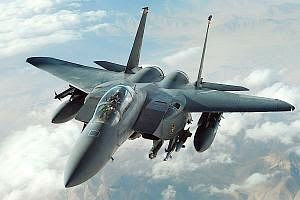 The F-15 C/D fighter planes, which first emerged in the mid-70s, are primarily engineered for air-to-air combat and air superiority missions. The F-15E strike eagle aircraft, first produced in the late 1980s, combine air-to-air attack technology with ground-strike mission ability.