Showing posts with label UK. Show all posts

Thursday, March 13, 2014

New radar technology to free-up radio spectrum

New radar technology could help free up highly sought after radio spectrum currently used for air traffic surveillance.
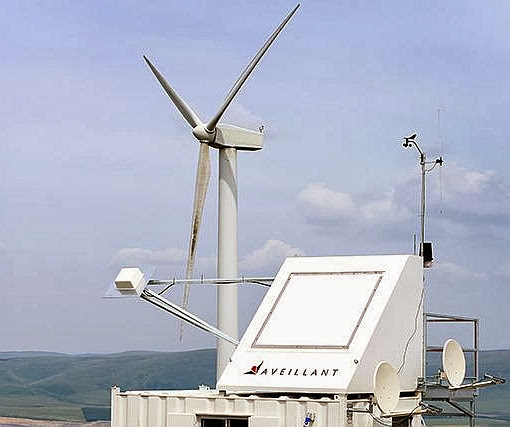
Aveillant's 3D Holographic Radar claims to mitigate the disruptive effect of wind farms on radar

The government has tasked the Civil Aviation Authority (CAA) with investigating options that would allow it to release bandwidth in the current air traffic radar spectrum allocation – in the ‘S Band’ between 2.7 and 2.9 GHz – to help meet its aspiration to free up 500 MHz of public spectrum by 2020.

In response, Cambridge technology firm Aveillant has been awarded a contract by the CAA to demonstrate the ability of its Holographic Radar technology to provide a spectrum-efficient alternative to S-band radar.

At present each radar typically has its own frequency assignment, but Aveillant hopes to demonstrate a surveillance system that can enable all air traffic control radars in the UK to operate through a single frequency assignment, separate from the ‘S Band’.

The firm’s radars use the L band frequency as opposed to the highly congested S band, used by current air traffic control radars and highly sought after by mobile phone operators.

Gordon Oswald, chief technology officer at Aveillant, said: “This is not a simple problem to solve, but based on our experience with Holographic Radar we’re confident that we are best placed to do so.

“Air traffic control radars cannot be simply shifted to another frequency, such as L band: this would then itself become too congested. At the same time, a much higher frequency is less suitable for long-range air traffic control radar due to atmospheric effects.

“This problem is ripe for a solution that changes the way air traffic radars occupy bandwidth. It’s going to be a demanding project to show how this solution will work – but one that we’re well equipped to handle.”

According to the firm, its 3D Holographic Radar is also proven to successfully mitigate the effect of wind farms on radar and has excelled in trials held by US and UK aviation stakeholders.

Source

Tuesday, March 4, 2014

Civil Aviation Authority trials Cambridge radar

The UK’s Civil Aviation Authority (CAA) is using novel radar technology from Cambridge business, Aveillant.

Aveillant CTO, Gordon OswaldIt has awarded a contract to the company to demonstrate the ability of its Holographic RadarTM technology to provide a spectrum-efficient alternative to S-band primary air traffic surveillance radar.

The UK government aspires to release 500 MHz of public spectrum by 2020 and has tasked the CAA with investigating the viability of options to release bandwidth in the current air traffic radar spectrum allocation in the ‘S Band’ between 2.7 and 2.9 GHz.

The CAA is investigating two options: to change and reduce the spectrum occupied by existing aerodrome radars, and to exploit new, spectrum efficient solutions that have potential to provide additional benefits to aviation.

Monday, December 9, 2013

Top Secret - Menwith Hill

Top Secret - Menwith Hill

Originally designed as a radar base, the capabilities of the station were upgraded during the Cold War to monitor and intercept communications from "unfriendly nations". It was during the 1970s that the base started to arouse the suspicions of civilian investigators after it fell under the auspices of the shadowy US National Security Agency in 1966 (although the site had been available to US Forces as far back as 1955).

Sunday, September 29, 2013

Sound Mirrors

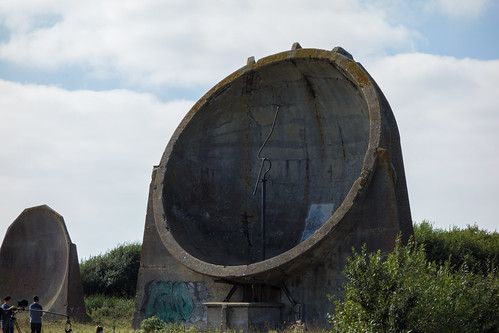
"Sound Mirrors" also known as "Acoustic Mirrors" at Denge near Greatstone and Dungeness. This is a former RAF site where in the late twenties and early thirties, experimental buildings were built to provide early warning of aircraft reaching Britain. The "ears" were designed to capture sound.

Sound Mirrors also known as Acoustic Mirrors at Denge near Greatstone and Dungeness

You can only get close to the Sound Mirrors on a couple of days a year. When we visited, a Sony crew were filming some kind of promotional video.

Source

Tuesday, January 3, 2012

Radar Sunset

A slight colour to the afternoon sky at the NATS Maybury Radar Station, Plasterfield.

A slight colour to the afternoon sky at the NATS Maybury Radar Station, Plasterfield.

Monday, June 20, 2011

Acoustic mirror at Denge

Acoustic mirror at Denge

Prior to World War II and the invention of radar, acoustic mirrors were built as early warning devices around the coasts of Great Britain, with the aim of detecting airborne invasions. The most famous of these devices still stand at Denge on the Dungeness peninsula and at Hythe in Kent. Other examples exist in other parts of Britain (including Sunderland, Redcar, Boulby, Kilnsea) and Selsey Bill, and Bahar ic-Caghaq in Malta. The Maltese sound mirror is known locally as "the ear" (il-Widna) and appears to be the only sound mirror built outside Great Britain.

Tuesday, June 15, 2010

Sunset…

Type 968 mast head surveillance radar for the SEAWOLF missile system

Thursday, September 24, 2009

Abandoned Radar Station - RAF Stenigot, Lincolnshire, England

After the invention of radar in the late 1930s, the UK built a string of early-detection systems along its coastline. A major hub in this "Chain Home" was the RAF Stenigot, in Lincolnshire. In the 1950s, the station was updated with tropospheric scatter dishes, which allowed the army to transit and receive microwave signals by beaming them through the troposphere-the lowest level of the Earth's atmosphere. They were eventually decommissioned in the 1980s, and today the abandoned dishes are used for everything from climbing to skateboarding.

Abandoned Radar Station - RAF Stenigot, Lincolnshire, England

Photo: DigiTaL~NomAd

Thursday, February 12, 2009

UK Hails Latest Spy Plane as a Success

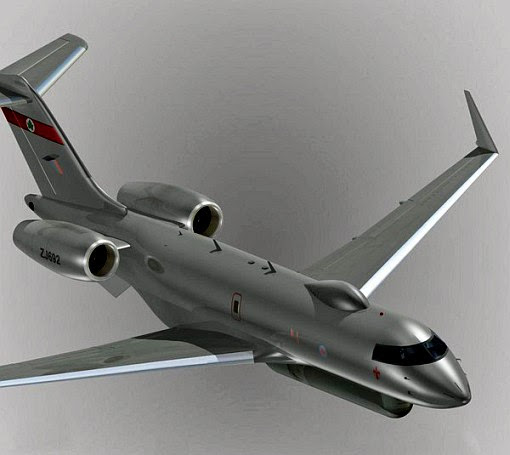
The UK Royal Air Force (RAF) has hailed the Airborne Stand-Off Radar (ASTOR) system on the Sentinel R1 aircraft as a success after returning from trials in Afghanistan.

The aircraft is capable of operating for over nine hours at a time, during which it recognises and detects moving, static and fixed targets on the ground.

UK Minister for Defence, Equipment and Support, Quentin Davies said that the hugely sophisticated system successfully demonstrated what it could do in Afghanistan.

Raytheon Sentinel aicraft with ASTOR radar

"The ASTOR system is a key element of the modern network-enabled battlefield, through which our forces can learn about the movement of enemy forces and react to prevent those threats to our troops," he said.

Wednesday, December 3, 2008

RAF's Innovative ASTOR Radar Now in Service

The British MoD has officially declared the innovative ASTOR (airborne stand-off radar) system in service onboard the RAF's Sentinel R1 aircraft.

The ASTOR System, which was developed under a £860m contract by Raytheon Systems, provides new all-weather intelligence, surveillance, target acquisition and reconnaissance capability to assist commanders on the battlefield.

Royal Air Force Sentinel R.1 visits the National Test Pilot School at Mojave

ASTOR is also designed to communicate with a wide range of other systems and networks and is therefore at the heart of the UK's network-enabled capability (NEC).

Minister for Defence Equipment and Support, Quentin Davies said that the advanced technology will deliver exceptional surveillance capabilities. "The ASTOR radar will link up with other intelligence-gathering equipment providing commanders with a complete picture of the ground allowing them to make immediate decisions on operations," Davies said.