Showing posts with label Cassidian. Show all posts

Tuesday, April 8, 2014

Airbus Defence and Space receives radar contract extension in the Middle East

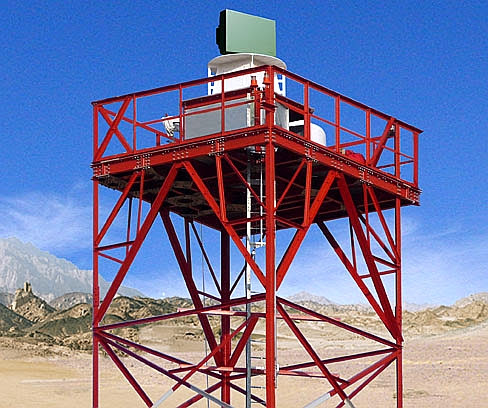
Airbus Defence and Space has been awarded a contract for the delivery of four of its Spexer 2000 security radars to further improve the surveillance of the borders of a major Middle Eastern country. The contract is an extension to an existing contract for the delivery of more than 40 Spexer 2000 radars, which have been operating successfully for almost two years now.

The Spexer 2000 security radar improves the surveillance of borders substantially. Photo: Airbus Defence and Space

Thomas Müller, head of the Business Line Electronics at Airbus Defence and Space, said: “Spexer 2000 is using state-of-the-art Active Electronically Scanning Array (AESA) technology, which provides a multi-tasking and multi-mode capability, and increases the detection and target assessment capability substantially. Due to this, Spexer 2000 can replace several conventional radars.”

Tuesday, March 4, 2014

Airbus Defence and Space naval radars to be showcased at DIMDEX 2014, booth No 435

At DIMDEX 2014, it's the first time that Airbus Defence and Space - a new division within the Airbus Group – is publicly present with all its four business lines at an exhibition in the Middle East region. The division has been formed by combining the business activities of Cassidian, Astrium and Airbus Military. At previous DIMDEX shows just Cassidian was present with its defence and security portfolio.

Airbus Defence and Space is Europe’s number one defence and space enterprise, the second largest space business worldwide and among the top ten global defence enterprises. It employs some 40,000 employees generating revenues of approximately €14 billion per year.

Within this new organisation Airbus Defence and Space is reinforcing its capabilities to service the customers better with a one-stop-shop offering an integrated portfolio based on one sales organisation under one strong brand, continue to build on a strong and reliable partnership with one known face to the customer and present the integrated and innovative product and services portfolio at competitive prices. The new Division started operating at executive level as of 1 January 2014.

Airbus Defence and Space is composed of four business lines: Military Aircraft; Space Systems; Communication, Intelligence & Security (CIS); and Electronics. It brings together a wide portfolio to continue to meet the complex needs of its customers across the world.

At DIMDEX 2014, it's the first time that Airbus Defence and Space - a new division within the Airbus Group – is publicly present with all its four business lines at an exhibition in the Middle East region. The division has been formed by combining the business activities of Cassidian, Astrium and Airbus Military. At previous DIMDEX shows just Cassidian was present with its defence and security portfolio.
Airbus Defence & Space TRS-4D AESA radar will be fitted onboard German Navy's future F125 frigates. Picture: Airbus Defence & Space

The business line Electronics will show a new generation of naval radars with unprecedented capabilities for the surveillance of sea areas and countering asymmetric threats:

TRS-4D is the innovative step from conventional radar into a "new dimension" of operational capability. It enables ships from patrol vessels to frigate size to exert the different detection tasks of a ship-borne medium range surveillance and target acquisition radar, in blue waters and also in complex littorals with high target densities. It performs faster, more accurate and against a wider scope of targets than conventional radars. TRS-4D provides navies and coast guards with the benefits of solid-state based AESA technology, which up to now has been available to highly expensive systems only. A non-rotating variant with four fixed array panels is under production for the new F125 frigates of the German Navy.

At DIMDEX 2014, it's the first time that Airbus Defence and Space - a new division within the Airbus Group – is publicly present with all its four business lines at an exhibition in the Middle East region. The division has been formed by combining the business activities of Cassidian, Astrium and Airbus Military. At previous DIMDEX shows just Cassidian was present with its defence and security portfolio.
Airbus Defence & Space TRSS (Tactical Radar for Surface Surveillance).
Picture: Airbus Defence & Space

Also on display is TRSS (= Tactical Radar for Surface Surveillance), a new naval X-Band radar optimized for the detection of extremely small objects and countering asymmetric threats. Based upon the latest AESA radar technology (AESA = Active Electronically Scanning Array), TRSS substantially increases the detection capabilities, and thus the protection level of navy ships and coast guard vessels. TRSS is able to detect and distinguish small objects precisely at close ranges, e.g. individual swimmers. These features give ship operators an optimal overview of the situation, e.g. against terrorist attacks, and enable ships to monitor movements on land.

Source

Thursday, July 26, 2012

Cassidian announces passive radar system

Cassidian, the German defense and security division of EADS, is in the news with development of a stealth radar system.

It said its "passive radar" system can not only locate difficult-to-detect stealth aircraft, the system itself is practically undetectable since it doesn't emit radiation. Instead, it analyses radiation reflections from other emitters, such as radio and television stations, to detect objects.

B-2 Stealth Bomber"The principle of passive radar has been known for a long time," says Elmar Compans, head of Sensors and Electronic Warfare at Cassidian. "However, we have now integrated the latest capabilities of digital receiver and signal processing technology to significantly enhance range and detection accuracy by monitoring various emitters at the same time."

Cassidian said its passive radar meets the requirements of civil and military airspace control, which couldn't be fully met with standard emitting radar: In civil application, passive radar makes cost-effective air traffic control possible without any additional emissions and without demands on transmission frequencies; in military applications, it provides large-area surveillance using networked receivers but cannot be located by hostile forces.

"The particular characteristics of the omnipresent radio signals used for operation enable detection of even objects that are difficult to detect, such as stealth aircraft or stealth ships," Cassidian said.

"A further advantage of the new technology is its increased detection capacity in areas of radar shadow such as mountainous terrain and its capability to locate extremely slow and low flying objects."

The system is also mobile. It can be deployed in a vehicle of the size of a commercial van.

Testing of the system, including at Stuttgart Airport, has proved successful and a production prototype system will be manufactured for evaluation program by Cassidian and its customers by the end of the year.

A demonstrator passive radar system has been delivered to the German Federal Office of Defense Technology and Procurement, the company said.

In other Cassidian developments, the reported its Barracuda unmanned aerial system has completed a series of test flights at a military airfield in Canada.

Five tests were conducted this month and last and involved the Barracuda demonstrator flying in combination with a modified Lear jet to simulate another unmanned aerial vehicle.

In the tests the two aircraft flew missions where they each had different role profiles that were autonomously coordinated and synchronized with each other.

Cassidian said that coordination between the two aircraft was mostly automated but missions could be adapted by uploading new mission data while the aircraft were in the mission zone through the use of a new network-centric data link.

Flight test engineers transmitted new individual waypoints to the aircraft as well as entire mission segments from the ground station to the UAS in flight.

"With these latest successful flights by our UAS technology demonstrator, we have made another great leap forward in our developments for the world's most promising future markets in our industry," said Cassidian Chief Executive Officer Stefan Zoller.

The Barracuda demonstrator was designed as a technology test bed. It has a modular structure, enabling a variety of systems and flight profiles to be tested and a wide range of mission requirements to be demonstrated.

Its avionics system was also developed as an open and modular structure, the company said.

Source