Wednesday, November 28, 2012
Tuesday, June 28, 2011
International X-Band Weather Radar Workshop, 14-16 November, 2011, Delft, Netherlands
The installation of compact X-band weather radars becomes increasingly popular as such radars deliver rainfall rate information in a very high spatial and temporal detail which are required for applications such as the monitoring of rainfall in urban areas or water catchment hydrology.

However, X-band weather radar observations pose challenges e.g. in terms of the prevailing scattering mechanisms and the significant attenuation by rain which makes the seamless application of methods and algorithms developed for S- and C-band disputable.
The objective of this workshop is to serve as a platform for experts on X-band weather radar in order to discuss the latest developments in the field. A plenary discussion is scheduled to evaluate the state-of-the-art for rainfall measurements with X-band weather radar and to discuss the possibility of writing a reference book on this topic.
Prof. Dr. Clemens Simmer
Prof. Dr. Herman Russchenberg
Sunday, December 27, 2009
Short-Wavelength Technology and the Potential For Distributed Networks of Small Radar Systems
David McLaughlin, David Pepyne, Brenda Philips, James Kurose, Michael Zink, David Westbrook, Eric Lyons, Eric Knapp, Anthony Hopf, Alfred Defonzo, Robert Contreras, Theodore Djaferis, Edin Insanic, Stephen Frasier, V. Chandrasekar, Francesc Junyent, Nitin Bharadwaj, Yanting Wang, Yuxiang Liu, Brenda Dolan, Kelvin Droegemeier, Jerald Brotzge, Ming Xue, Kevin Kloesel, Keith Brewster, Frederick Carr, Sandra Cruz-Pol, Kurt Hondl, and Pavlos Kollias, 2009: Short-Wavelength Technology and the Potential For Distributed Networks of Small Radar Systems. Bull. Amer. Meteor. Soc., 90, 1797–1817. doi: http://dx.doi.org/10.1175/2009BAMS2507.1 -
http://journals.ametsoc.org/doi/abs/10.1175/2009BAMS2507.1
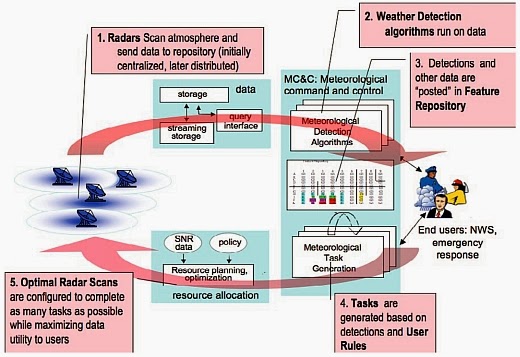 Flow diagram depicting the major processing steps of the closed-loop software architecture
Abstract. Dense networks of short-range radars capable of mapping storms and detecting atmospheric hazards are described. Composed of small X-band (9.4 GHz) radars spaced tens of kilometers apart, these networks defeat the Earth curvature blockage that limits today's long-range weather radars and enables observing capabilities fundamentally beyond the operational state-of-the-art radars. These capabilities include multiple Doppler observations for mapping horizontal wind vectors, subkilometer spatial resolution, and rapid-update (tens of seconds) observations extending from the boundary layer up to the tops of storms. The small physical size and low-power design of these radars permits the consideration of commercial electronic manufacturing approaches and radar installation on rooftops, communications towers, and other infrastructure elements, leading to cost-effective network deployments. The networks can be architected in such a way that the sampling strategy dynamically responds to changing weather to simultaneously accommodate the data needs of multiple types of end users. Such networks have the potential to supplement, or replace, the physically large long-range civil infrastructure radars in use today.