Showing posts with label Germany. Show all posts

Thursday, March 20, 2014

Poland considers MEADS anti-missile radar

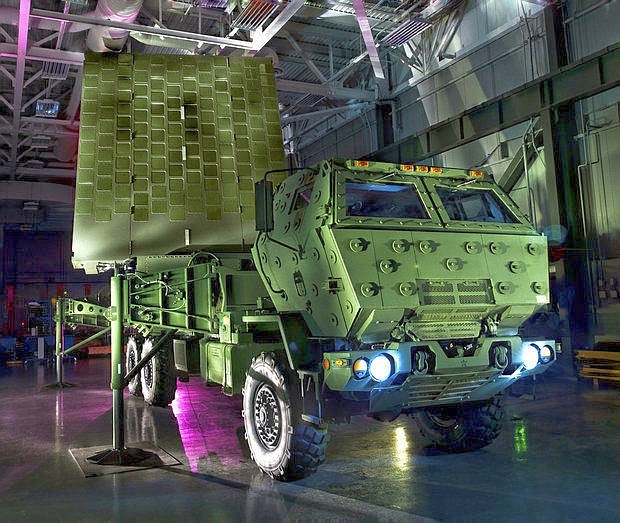
This surveillance radar for the MEADS missile defense system was designed and developed at the Lockheed Martin plant in Salina, NY. Costs were shared by NATO allies the United States, Germany and Italy. The surveillance radar can search 360-degrees for incoming missiles, planes and drones and be hauled around on the back of a truck. (Courtesy Lockheed Martin)

WASHINGTON -- A missile defense system the United States has no plans to deploy may find new life in Poland, where leaders Tuesday welcomed Vice President Joe Biden amid rising tensions over Russia's takeover of Crimea.

As Biden visited with President Bronislaw Komorowski in Warsaw, other Polish leaders met privately Tuesday with executives from MEADS International, the consortium developing the Medium Extended Air Defense System.

Poland selected MEADS International, and its main U.S. partner -- Lockheed Martin Corp. -- as one of four finalists for a contract worth up to $5 billion to modernize its air and missile defense systems.

If MEADS wins the competition, it would help boost business at Lockheed Martin in Salina, which developed the 360-degree search radar for the anti-missile system.
The other finalists for the Polish contract are a French consortium that includes Thales and MBDA, the Israeli government, and Massachusetts-based Raytheon, developer of the Patriot anti-missile system.

Thursday, November 14, 2013

MEADS Dual Intercept Flight Test 02

The Medium Extended Air Defense System (MEADS) intercepted and destroyed two simultaneous targets attacking from opposite directions during a stressing demonstration of its 360-degree air and missile defense (AMD) capabilities at White Sands Missile Range, N.M. The flight test achieved all criteria for success. Learn more…

MEADS International, a multinational joint venture headquartered in Orlando, Fla., is the prime contractor for the MEADS system. Major subcontractors and joint venture partners are MBDA in Italy and Germany, and Lockheed Martin in the United States. The MEADS program management agency NAMEADSMA is located in Huntsville, Ala.

Thursday, July 26, 2012

Cassidian announces passive radar system

Cassidian, the German defense and security division of EADS, is in the news with development of a stealth radar system.

It said its "passive radar" system can not only locate difficult-to-detect stealth aircraft, the system itself is practically undetectable since it doesn't emit radiation. Instead, it analyses radiation reflections from other emitters, such as radio and television stations, to detect objects.

B-2 Stealth Bomber"The principle of passive radar has been known for a long time," says Elmar Compans, head of Sensors and Electronic Warfare at Cassidian. "However, we have now integrated the latest capabilities of digital receiver and signal processing technology to significantly enhance range and detection accuracy by monitoring various emitters at the same time."

Cassidian said its passive radar meets the requirements of civil and military airspace control, which couldn't be fully met with standard emitting radar: In civil application, passive radar makes cost-effective air traffic control possible without any additional emissions and without demands on transmission frequencies; in military applications, it provides large-area surveillance using networked receivers but cannot be located by hostile forces.

"The particular characteristics of the omnipresent radio signals used for operation enable detection of even objects that are difficult to detect, such as stealth aircraft or stealth ships," Cassidian said.

"A further advantage of the new technology is its increased detection capacity in areas of radar shadow such as mountainous terrain and its capability to locate extremely slow and low flying objects."

The system is also mobile. It can be deployed in a vehicle of the size of a commercial van.

Testing of the system, including at Stuttgart Airport, has proved successful and a production prototype system will be manufactured for evaluation program by Cassidian and its customers by the end of the year.

A demonstrator passive radar system has been delivered to the German Federal Office of Defense Technology and Procurement, the company said.

In other Cassidian developments, the reported its Barracuda unmanned aerial system has completed a series of test flights at a military airfield in Canada.

Five tests were conducted this month and last and involved the Barracuda demonstrator flying in combination with a modified Lear jet to simulate another unmanned aerial vehicle.

In the tests the two aircraft flew missions where they each had different role profiles that were autonomously coordinated and synchronized with each other.

Cassidian said that coordination between the two aircraft was mostly automated but missions could be adapted by uploading new mission data while the aircraft were in the mission zone through the use of a new network-centric data link.

Flight test engineers transmitted new individual waypoints to the aircraft as well as entire mission segments from the ground station to the UAS in flight.

"With these latest successful flights by our UAS technology demonstrator, we have made another great leap forward in our developments for the world's most promising future markets in our industry," said Cassidian Chief Executive Officer Stefan Zoller.

The Barracuda demonstrator was designed as a technology test bed. It has a modular structure, enabling a variety of systems and flight profiles to be tested and a wide range of mission requirements to be demonstrated.

Its avionics system was also developed as an open and modular structure, the company said.

Source
Wednesday, October 19, 2011

Missile defense system fight in Washington puts Lockheed's Syracuse-area jobs in crosshairs

This is the first publicly released photo of a prototype of the MEADS missile defense system surveillance radar that was designed and developed at the Lockheed plant in Salina, NY, for the U.S. Army. The surveillance radar can search 360-degrees for incoming missiles, planes and drones and be hauled around on the back of a truck. (Photo supplied by Lockheed Martin Corp.)

Photo supplied by Lockheed Martin Corp.This is the first publicly released photo of a prototype of the MEADS missile defense system surveillance radar that was designed and developed at the Lockheed plant in Salina, NY, for the U.S. Army. The surveillance radar can search 360-degrees for incoming missiles, planes and drones and be hauled around on the back of a truck.

Washington, D.C. -- Hundreds of Central New York workers building a long-delayed missile defense system could lose their jobs if Congress proceeds with a plan to eliminate the program’s funding.

Lockheed Martin’s plant in Salina has a $625 million share of the multibillion-dollar contract to design and develop the Medium Extended Air Defense System, or MEADS.

About 325 Lockheed engineers and technicians in Salina have been building two radars to spot and track enemy missiles, fighter jets or drones — and target them with interceptor missiles.

The United States, with partners Germany and Italy, already has spent $3.4 billion to develop its replacement of the Army’s aging Patriot missile defenses.

Tuesday, September 20, 2011

Exploring Abandoned Teufelsberg

Just outside of Berlin stands the Teufelsberg - or Devil's Mountain-an artificial hill made of millions of pounds of rubble from wartime Berlin (at the very bottom lies Albert Speer's unfinished technical college). After the war ended, the National Security Agency (NSA)built a series of buildings and geodesic radar domes atop the 280-foot high hill, in order to monitor Soviet activity. It was decommissioned after the Berlin Wall fell, though the ruins still stand today.

Exploring Abandoned Teufelsberg


Sunday, March 8, 2009

EDA Approves Next-Gen Space-Based Military Surveillance System

The European Defence Agency (EDA) has agreed to approve a project for the next generation of European military earth observation satellites.

The multinational space-based imaging system (MUSIS) project has been launched by six European Union Member States: Belgium, Germany, Greece, France, Italy and Spain.

The MUSIS project aims at establishing a multinational space-based imaging system for surveillance, reconnaissance and observation to ensure continuity of services from the current French Helios II, German SAR LUPE and Italian Cosmo-Skymed and Pléiades systems, from 2015-2017 onwards.

EDA Head, Javier Solana said that he welcomed the initiative of the EU member states in approving this critical capability.

"Space-based related assets are critical to improve European military capabilities, including for information gathering," Solana said.

EDA's chief executive, Alexander Weis said that the EDA was proving its value by bringing together member states as well as by connecting military to civil space agendas.

"We will liaise with the commission and the European Space Agency to ensure complementing research and technology, and to seek other synergies," said Weis.

One of the roles for EDA will be to seek synergies with earth observation programmes on the civilian side, in particular with the global monitoring for environment and security (GMES) programme of the European Commission.

By Daniel Garrun.

Friday, January 11, 2008

FGAN/FHR

FGAN/FHR (Forschungsgesellschaft für Angewandte Naturwissenschaften/ Forschungsinstitut für Hochfrequenzphysik und Radartechnik - Defense Research Facility for Applied Science/Research, Institute for High-frequency Physics and Radar Techniques), Wachtberg near Bonn, Germany.

Official site